

What is the largest organ of the body?
Did you answer skin? There is an ongoing debate as to who really is #1? Although skin is touted as “the largest organ of the body, the fascia, which underlays the skin directly and also wraps around every organ of the body, is considered much larger, often ignored and largely unknown.
So fascia, or connective tissue, may be our body’s largest organ. Fascia is a very densely woven covering that adheres to every bone, muscle, nerve, artery and vein, as well as all of our internal organs: including the heart, lungs, brain and spinal cord.
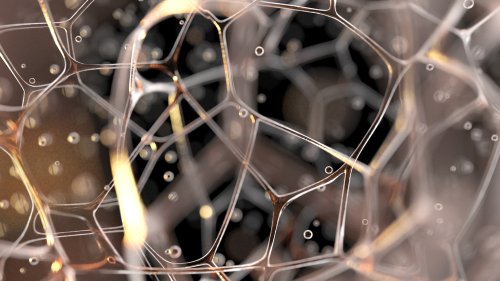
Fascia is a web-like network of connective tissue that surrounds & holds every organ, blood vessel, bone, and fiber in place!
Let’s focus on the fascia. Fascia is primarily made up of collagen and water. Its quality is therefore affected by both our age (since collagen production decreases with age) and by our levels of hydration.
When fascia is healthy and hydrated, it is supple and glides, slides, twists and bends easily with movement.
Example: Prolonged sitting can cause tension in the lower back muscles and compression of the lumbar and sacral vertebrae. By stretching the fascia, we directly influence the quality of the surrounding tissues, as they are intricately connected. Yoga trains the whole body to make it more flexible and supple. The principle is simple: Yoga movements stretch fascial strands, rendering them more moist and supple and help minimize prolonged discomfort of the lower back and hips.
” If you are unable to attain a goal, do not abandon the goal. Rather, change your strategy to reach it.” ~Chinese Proverb
As the Chinese Proverb above reminds us, the tried-and-true path is not always the best way to achieve a goal. In our practice, as in life, oftentimes we have to look at the body through “new” eyes to get to where we want to be.
So, do you think you might have a few kinks in your fascia? In a sense, if you’re already staying physically active, you’re exercising and stretching regularly, you’re ahead of the game. Muscles and fascia are so interwoven that you can’t affect one without affecting the other. If we spend months, years, even decades sitting at a desk and think that a few hours in the gym per week are going to undo all that, we’re probably kidding ourselves. Stretching a muscle with bound-up fascia is a bit like trying to stretch a knotted bungee cord: You’ll get much greater results if you get the knots out first. Some of the best methods for untying these knots is to move and stretch yourself in fascia-friendly patterns, like yoga. Presented as a practical manual, JingJin Yoga: Stretches for the Fascia Combining the Asanas of Yoga with the Tendinomuscular Pathways of Chinese Medicine introduces an innovative modality that Teddy Piotrowski and I developed (The new eyes we spoke about earlier). This is a marriage of the JingJin of Chinese Medicine (The “Tendinomuscular Meridians”) with the ancient poses of Yoga. We have refined the poses to specifically target the fascia through which the JingJin flows. The JingJin are part of the meridian system that maps channels of energy in Traditional Chinese Medicine. They are a network of superficial channels branching off the principal pathways to feed the skeletal muscles along the 12 principal meridians. “Jing” refers to channels, thus the English translation of “Tendinomuscular Meridians.” The path of these energy channels deviates from the regular meridians of Chinese Medicine, which follow a distinct path like a river. The word “Jin” is translated as “sinew” or “fascia” and includes both muscle and tendon.The JingJin are more like deltas spreading in a broad zone through the fascia to nourish muscles, tendons, and ligaments.The authors found that by putting the awareness of the trajectory of these superficial meridians together with a yoga pose, a JingJin refinement of a yoga asana produced an immediate improvement in results. The result of our combination of a JingJin map with a yoga pose is a JingJin Stretch.
These stretches can:
Stimulate the immune system·
Improve the circulation of blood and protective Qi·
Ease stiff, strained or twisted muscles, spasms and pain along the course of the JingJin meridians
The “reset” and realignment of the fascia can include, among other effects·
Reduction of tension and discomfort·
A felt sense of well-being·
Stress reduction and increased resilience
These deceptively simple stretches profoundly benefit the whole body in many surprising ways.
Coming in November, 2023
Stay tuned to this blog for the release date.

A Practical Manual
JingJin Yoga Fascial Stretches Combining Asanas & Energy Pathways by
Deborah Valentine Smith,L.M.T., Dipl. ABT (NCCAOM®), AOBTA® Certified Instructor, Authorized JinShin Do® Bodymind Acupressure® Teacher
Barbara “Teddy” Piotrowski R.N., B.A., Dipl. ABT (NCCAOM®), Board Certified Holistic Nurse, Shiatsu Practitioner, Certified Yoga Therapist, Meditation Specialist


 Bodymind Treasures
Leave a comment