with Debby Valentine Smith & Teddy Piotrowski Thursday January 23, 2024 6:30-8PM $25/student
In this online class we will learn about the (JingJin) Fascial Tendinomuscular Meridians and an approach to basic yoga stretches that stimulates and opens these pathways of Qi – known as “prana” in yoga.
Discover awareness with the use of breath and movement along these channels to unravel the tension and fascial restrictions associated with physical, mental and emotional stress and deepen your attunement to the subtle body.
We will explore how yoga students can incorporate the releasing power of these meridians into their daily practice for self-care.
Included in this class is a 26 minute full-body JingJin Yoga practice.
You can practice using 1)a yoga mat on the floor, 2) an elevated surface like a bed, sofa or massage table, 3) an armless chair. Bring two small blankets, two bed or sofa pillows and an open mind. ———————————————————————————————— Space is limited.
Payment options to reserve a seat for the January 23rd class Greater Harmony accepts personal checks or Venmo (online payment). Please send checks to: Barbara “Teddy” Piotrowski PO Box 222 25 S. Haddon Ave. Haddonfield, NJ 08033 or VENMO: @Barbara-Teddy-Piotrowski
and include your contact information: Name__________________________________________________________ Address________________________________City/State/Zip_____________ Email__________________________________Phone__________________
Embrace the journey of healing by creating a safe space within your practice. Establishing a sense of safety is crucial when working with trauma in the body, allowing for deeper emotional and physical release. The JingJin Yoga technique meets those requirements. Slowly approaching the stretch allows awareness of the reactions.
The method is to first identify which of the tendinomuscular meridians (TMM) run through the painful area and to pick the stretch that addresses it. For the yoga practitioner working on themselves, the yoga posture that aligns the whole tract along the TMM will remind the body of its natural path from head to toe. This is coupled with respectful awareness of the signals of the body, including the positive responses of flow as the pathways of Qi and Blood are improved. Unlock the potential of your body by understanding how the fibers in your muscles respond to movement. As these fibers loosen, they create a natural flow that enhances lubrication, allowing the tissue to return to its original state, promoting overall flexibility and health.
Less is More By integrating these principles, practitioners can enhance their practice and promote a more profound connection to movement and flexibility. Explore the transformative power of JingJin Yoga by embracing the principle of ‘less is more.’ Allow your body to naturally open and stretch without force, leading to a deeper connection and enhanced flexibility.
The practice of JingJin Yoga encourages a mindful examination of bodily sensations, allowing individuals to recognize and respond to signals of tension, pain, or fear. This awareness fosters a deeper connection to oneself, promoting healing and personal growth.
Want to learn more about using JingJin with trauma?
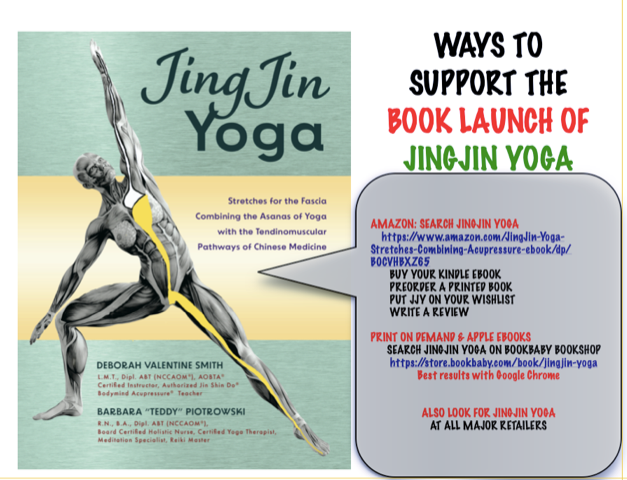
Purchase your own copy of JJY with links to accompanying videos at
Each JingJin Stretch uses a Yoga asana to smooth the kinks and enhance energy flow in the fascia along one pair of hand/foot muscle meridians. You can do all six JingJin stretches to keep the fascia all over the body supple, hydrated and energized. You can also choose a specific stretch or two to ease stiff, strained or twisted muscles and to calm spasms and pain along the course of the related meridians.
When would you choose the Shao Yang JingJin stretch?
When would you choose the Shao Yang JingJin stretch?
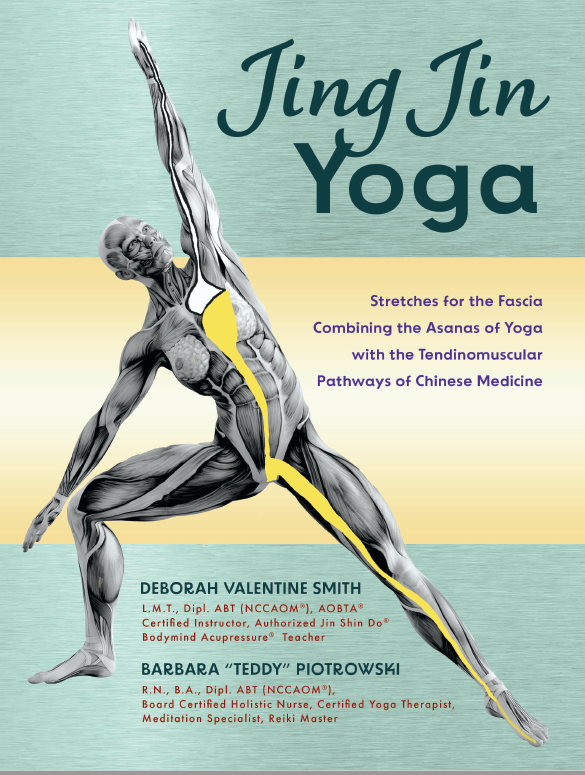
Look at the diagram of the Shao Yang pathway on the right. Do any of the muscles/areas along the green and red pathways want attention? Are they sending you messages of pain, tension or weakness? Do you see yourself in the picture? What about your neck and shoulders? Pain in the arm? Pain down the outside of the leg? Foot pain?
Specific areas along these meridians:
Triple Warmer: muscles of thering finger, elbow, arm, shoulder, neck, jaw and tongue.
Gall Bladder: muscles of the4th toe, knee (inability to bend or extend), side of the rib cage, breast, clavicle, neck, and those extending from the sacrum upward to below the ribs; muscles of the eyes. (Note: the book also includes specific muscles.
What is the Approach?
What is the Approach?
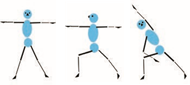
The Shao Yang JingJin Stretch uses the Warrior/Side Angle yoga asana to align and open the fascia along the Triple Heater and Gall Bladder muscle meridians. Mental focus is important to the method. The book and the video available through the book provide a step by step guide for the mindfulness component of each stretch.
The role of the fascia in the human body has been getting a lot of attention. Its effects are far-reaching because it surrounds and holds every organ, blood vessel, bone, and fiber in place! In short, it is everywhere and affects everything! The trick is to keep the fascia “unstuck” so that it is supple and hydrated and can glide, slide, twist, and bend with movement. Bodyworkers know about it because itis everywhere we touch. Yoga practitioners know about it because their asanas are designed to stretch it. JingJin Yoga is about combining those two Eastern wisdoms: Yoga and Chinese Medicine. Unlike other bodywork methods that use the principal energy pathways of acupressure and acupuncture, it focuses on the pathways that are dedicated specifically to the muscles and fascia – the JingJin. The authors have used the trajectories of the JingJin to fine-tune the asanas of Yoga and added the mind-body connection with the energy pathways through guided meditation. These deceptively simple stretches profoundly benefit the whole body in many surprising ways. When done regularly the effects are cumulative and endless!
I’ve been thinking about Doing and Non-Doing (Wu Wei) a lot recently. My first formal training in bodywork was in shiatsu. I remember learning the meridian stretches and putting the body through them with the intention of arriving at the full stretch. When I was working that way, my mind was asking questions like “Am I doing the right stretch?” “Do I have the correct angle, speed, pressure?” “Am I using the correct body mechanics?” It was only after I’d had some experience that I began to realize that getting these things “right” is not the goal. When I asked those questions, through my hands, of the bodymind I was touching, the questions became not, “Is this right?” but “What is your response to this?” and “What do you want/need right now?”
The goal is to let the body tell you about its connections and restrictions as you move toward the stretch. The stretch is the Doing. The listening is the Non-Doing. The same applies in acupressure. Pressing the right point isn’t the goal. The goal is to listen to what the points have to tell you about what the body needs and its strengths. In any case the goal is not the stretch or the point. They are just a way to begin a communication.
This really came home to me in the one craniosacral course I took. We were instructed to hold very lightly at the base of the skull and sense the tissue connections and restrictions through the whole body from those two points. I realized that this was one part of the technique I was using with the TendinoMuscular Meridians (TMMs). With a light touch, I was feeling the connections and restrictions in the tissue along the meridian. But more than that, by following the energy pathways that feed the muscles, my hands were reminding the body of the way back to natural, unstressed alignment. Deep releases were happening with very little effort. Non-Doing.
I think that most experienced practitioners of exercise and bodywork are using this approach in some way, whether their practice is personal or professional. They are using the physical technique to sense both the actual state of the tissues and their yearning to return to the optimum alignment of their natural state. The goal is to recognize and assist that yearning as it finds its way back. When that connection is being made it really isn’t necessary to push or pull the body into the form that is prescribed by the technique. A gentle touch or movement can be very powerful. The Qi (Yi) of intention assists the physical process.
This way of working is very important to the individual practice of JingJin Yoga, which I developed with Teddy Piotrowski, combining yoga postures and the TMMs. It does not merely prescribe positions or exercises. The practitioner is asking the same questions of their own body that they would ask working on another. “What is your response to this?” and “What do you want/need right now?” The important part of it is moving toward the position and listening to the body along the way, acknowledging the restrictions that need to be addressed rather than pushing the body past them. In this way, what needs to be released gets the attention it needs. Like untangling a knot, we start by looking for the piece that loosens when we find the right direction to pull. JingJin stretches initially use micro movements to find the tangle and then to find the alignment that begins to open it.
Practicing in this Non-Doing way, JingJin Yoga can assist in releasing muscle tension and increasing circulation without effort or pain. As my friend Teddy says of the work: “Less is more.”




 Bodymind Treasures
Comments