with Debby Valentine Smith & Teddy Piotrowski Thursday January 23, 2024 6:30-8PM $25/student
In this online class we will learn about the (JingJin) Fascial Tendinomuscular Meridians and an approach to basic yoga stretches that stimulates and opens these pathways of Qi – known as “prana” in yoga.
Discover awareness with the use of breath and movement along these channels to unravel the tension and fascial restrictions associated with physical, mental and emotional stress and deepen your attunement to the subtle body.
We will explore how yoga students can incorporate the releasing power of these meridians into their daily practice for self-care.
Included in this class is a 26 minute full-body JingJin Yoga practice.
You can practice using 1)a yoga mat on the floor, 2) an elevated surface like a bed, sofa or massage table, 3) an armless chair. Bring two small blankets, two bed or sofa pillows and an open mind. ———————————————————————————————— Space is limited.
Payment options to reserve a seat for the January 23rd class Greater Harmony accepts personal checks or Venmo (online payment). Please send checks to: Barbara “Teddy” Piotrowski PO Box 222 25 S. Haddon Ave. Haddonfield, NJ 08033 or VENMO: @Barbara-Teddy-Piotrowski
and include your contact information: Name__________________________________________________________ Address________________________________City/State/Zip_____________ Email__________________________________Phone__________________
Each JingJin Stretch uses a Yoga asana to smooth the kinks and enhance energy flow in the fascia along one pair of hand/foot muscle meridians. You can do all six JingJin stretches to keep the fascia all over the body supple, hydrated and energized. You can also choose a specific stretch or two to ease stiff, strained or twisted muscles and to calm spasms and pain along the course of the related meridians.
When would you choose the Shao Yang JingJin stretch?
When would you choose the Shao Yang JingJin stretch?
Look at the diagram of the Shao Yang pathway on the right. Do any of the muscles/areas along the green and red pathways want attention? Are they sending you messages of pain, tension or weakness? Do you see yourself in the picture? What about your neck and shoulders? Pain in the arm? Pain down the outside of the leg? Foot pain?
Specific areas along these meridians:
Triple Warmer: muscles of thering finger, elbow, arm, shoulder, neck, jaw and tongue.
Gall Bladder: muscles of the4th toe, knee (inability to bend or extend), side of the rib cage, breast, clavicle, neck, and those extending from the sacrum upward to below the ribs; muscles of the eyes. (Note: the book also includes specific muscles.
What is the Approach?
What is the Approach?
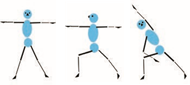
The Shao Yang JingJin Stretch uses the Warrior/Side Angle yoga asana to align and open the fascia along the Triple Heater and Gall Bladder muscle meridians. Mental focus is important to the method. The book and the video available through the book provide a step by step guide for the mindfulness component of each stretch.
The role of the fascia in the human body has been getting a lot of attention. Its effects are far-reaching because it surrounds and holds every organ, blood vessel, bone, and fiber in place! In short, it is everywhere and affects everything! The trick is to keep the fascia “unstuck” so that it is supple and hydrated and can glide, slide, twist, and bend with movement. Bodyworkers know about it because itis everywhere we touch. Yoga practitioners know about it because their asanas are designed to stretch it. JingJin Yoga is about combining those two Eastern wisdoms: Yoga and Chinese Medicine. Unlike other bodywork methods that use the principal energy pathways of acupressure and acupuncture, it focuses on the pathways that are dedicated specifically to the muscles and fascia – the JingJin. The authors have used the trajectories of the JingJin to fine-tune the asanas of Yoga and added the mind-body connection with the energy pathways through guided meditation. These deceptively simple stretches profoundly benefit the whole body in many surprising ways. When done regularly the effects are cumulative and endless!
Have you thought about the saying, “Mind over Matter”? Usually it comes up when you want to stop the body from doing something you don’t like or when you want to make it do something it doesn’t like. The upshot of this way of thinking is that the body is an opponent you have to outsmart. It’s like arm-wrestling. Both sides expend a lot of energy until one gives out. If you approach the kinks in the fascia with this attitude, the thinking goes that if you just pull against the resistance, it will eventually give.
There’s another way. Imagination. Introduce the idea to the body and listen to its response instead of applying force. If you approach the body respectfully and invite an exploration of the possibilities of release, you can avoid the its protective resistance to your idea of change. Meditators and practitioners of Asian Bodywork Therapy like Shiatsu, Acupressure, Tuina and Jin Shin Do® have noticed that intention has a profound effect on the movement of energy, which powers the movement of blood, which in turn has a profound effect on the condition of the tissues. So to enhance the flexibility of the tissue, you don’t necessarily have to literally pull on the fascia.
By imagining the effects of a stretch, especially including the feeling component of relaxation and ease, you can enlist the body in achieving the outcome.
Before you ask the body to change, imagine the goal and the feeling you are aiming toward . If you approach the position of a stretch slowly, listening to the body’s feedback to find the natural alignment and breathing into it, the opening can happen without resistance. This saves a lot of work.
The position of the stretch is not a goal to be reached by any means necessary. The stretch is a guideline, a pathway toward alignment . As you start from where you are, imagining the stretch rather than forcing it, , you are teaching your body how to get from where you are to where you’d like to be.
This comes down to the balance between doing and being. There is a natural alignment in the fascia that already exists and is part of the wisdom of the body. We don’t need to create something new if we work with the potential that is inherent in our physical makeup. Sometimes outside assistance may be necessary to liberate adhesions caused by long time immobility and dehydration, but for the most part, the best effects come from gentleness and suggestion.
Want to know more?
In our last article we introduced the JingJin (tendinomuscular meridians) and the JingJin Stretches that combine these superficial meridians with yoga poses. An important part of the technique is awareness, so each stretch includes guided imagery.
Coming in November, 2023
A Practical Manual
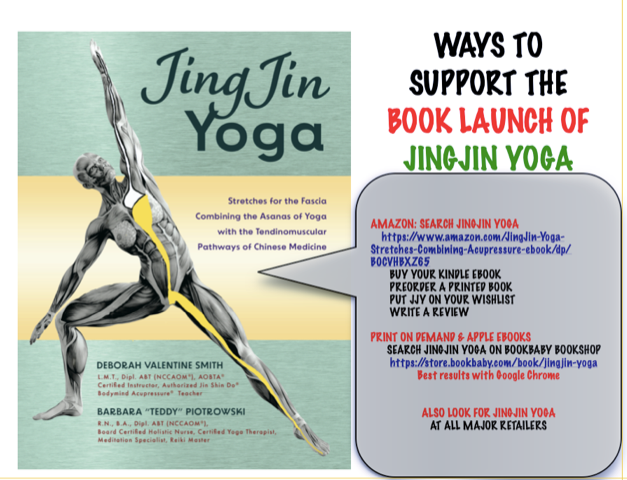
JingJin Yoga Fascial Stretches Combining the Asanas of Yoga with the TendinomuscularPathways of Chinese Medicine.
Did you answer skin? There is an ongoing debate as to who really is #1? Although skin is touted as “the largest organ of the body, the fascia, which underlays the skin directly and also wraps around every organ of the body, is considered much larger, often ignored and largely unknown.
So fascia, or connective tissue, may be our body’s largest organ. Fascia is a very densely woven covering that adheres to every bone, muscle, nerve, artery and vein, as well as all of our internal organs: including the heart, lungs, brain and spinal cord.
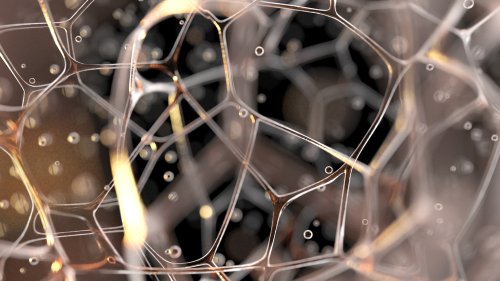
Fascia is a web-like network of connective tissue that surrounds & holds every organ, blood vessel, bone, and fiber in place!
Let’s focus on the fascia. Fascia is primarily made up of collagen and water. Its quality is therefore affected by both our age (since collagen production decreases with age) and by our levels of hydration.
When fascia is healthy and hydrated, it is supple and glides, slides, twists and bends easily with movement.
Example: Prolonged sitting can cause tension in the lower back muscles and compression of the lumbar and sacral vertebrae. By stretching the fascia, we directly influence the quality of the surrounding tissues, as they are intricately connected. Yoga trains the whole body to make it more flexible and supple. The principle is simple: Yoga movements stretch fascial strands, rendering them more moist and supple and help minimize prolonged discomfort of the lower back and hips.
” If you are unable to attain a goal, do not abandon the goal. Rather, change your strategy to reach it.” ~Chinese Proverb
As the Chinese Proverb above reminds us, the tried-and-true path is not always the best way to achieve a goal. In our practice, as in life, oftentimes we have to look at the body through “new” eyes to get to where we want to be.
So, do you think you might have a few kinks in your fascia? In a sense, if you’re already staying physically active, you’re exercising and stretching regularly, you’re ahead of the game. Muscles and fascia are so interwoven that you can’t affect one without affecting the other.If we spend months, years, even decades sitting at a desk and think that a few hours in the gym per week are going to undo all that, we’re probably kidding ourselves. Stretching a muscle with bound-up fascia is a bit like trying to stretch a knotted bungee cord: You’ll get much greater results if you get the knots out first. Some of the best methods for untying these knots is to move and stretch yourself in fascia-friendly patterns, like yoga. Presented as a practical manual, JingJin Yoga: Stretches for the Fascia Combining the Asanas of Yoga with the Tendinomuscular Pathways of Chinese Medicine introduces an innovative modality that Teddy Piotrowski and I developed (The new eyes we spoke about earlier). This is a marriage of the JingJin of Chinese Medicine (The “Tendinomuscular Meridians”) with the ancient poses of Yoga. We have refined the poses to specifically target the fascia through which theJingJinflows. The JingJin are part of the meridian system that maps channels of energy in Traditional Chinese Medicine. They are a network of superficial channels branching off the principal pathways to feed the skeletal muscles along the 12 principal meridians. “Jing” refers to channels, thus the English translation of “Tendinomuscular Meridians.” The path of these energy channels deviates from the regular meridians of Chinese Medicine, which follow a distinct path like a river. The word “Jin” is translated as “sinew” or “fascia” and includes both muscle and tendon.The JingJin are more like deltas spreading in a broad zone through the fascia to nourish muscles, tendons, and ligaments.The authors found that by putting the awareness of the trajectory of these superficial meridians together with a yoga pose, a JingJin refinement of a yoga asana produced an immediate improvement in results. The result of our combination of a JingJinmap with a yoga pose is a JingJin Stretch.
These stretches can:
Stimulate the immune system·
Improve the circulation of blood and protective Qi·
Ease stiff, strained or twisted muscles, spasms and pain along the course of the JingJin meridians
The “reset” and realignment of the fascia can include, among other effects·
Reduction of tension and discomfort·
A felt sense of well-being·
Stress reduction and increased resilience
These deceptively simple stretches profoundly benefit the whole body in many surprising ways.
Coming in November, 2023
Stay tuned to this blog for the release date.
A Practical Manual
JingJin Yoga Fascial Stretches Combining Asanas & EnergyPathways by








 Bodymind Treasures
Comments