

I’ve been thinking about Doing and Non-Doing (Wu Wei) a lot recently. My first formal training in bodywork was in shiatsu. I remember learning the meridian stretches and putting the body through them with the intention of arriving at the full stretch. When I was working that way, my mind was asking questions like “Am I doing the right stretch?” “Do I have the correct angle, speed, pressure?” “Am I using the correct body mechanics?” It was only after I’d had some experience that I began to realize that getting these things “right” is not the goal. When I asked those questions, through my hands, of the bodymind I was touching, the questions became not, “Is this right?” but “What is your response to this?” and “What do you want/need right now?”
The goal is to let the body tell you about its connections and restrictions as you move toward the stretch. The stretch is the Doing. The listening is the Non-Doing. The same applies in acupressure. Pressing the right point isn’t the goal. The goal is to listen to what the points have to tell you about what the body needs and its strengths. In any case the goal is not the stretch or the point. They are just a way to begin a communication.
This really came home to me in the one craniosacral course I took. We were instructed to hold very lightly at the base of the skull and sense the tissue connections and restrictions through the whole body from those two points. I realized that this was one part of the technique I was using with the TendinoMuscular Meridians (TMMs). With a light touch, I was feeling the connections and restrictions in the tissue along the meridian. But more than that, by following the energy pathways that feed the muscles, my hands were reminding the body of the way back to natural, unstressed alignment. Deep releases were happening with very little effort. Non-Doing.
I think that most experienced practitioners of exercise and bodywork are using this approach in some way, whether their practice is personal or professional. They are using the physical technique to sense both the actual state of the tissues and their yearning to return to the optimum alignment of their natural state. The goal is to recognize and assist that yearning as it finds its way back. When that connection is being made it really isn’t necessary to push or pull the body into the form that is prescribed by the technique. A gentle touch or movement can be very powerful. The Qi (Yi) of intention assists the physical process.
This way of working is very important to the individual practice of JingJin Yoga, which I developed with Teddy Piotrowski, combining yoga postures and the TMMs. It does not merely prescribe positions or exercises. The practitioner is asking the same questions of their own body that they would ask working on another. “What is your response to this?” and “What do you want/need right now?” The important part of it is moving toward the position and listening to the body along the way, acknowledging the restrictions that need to be addressed rather than pushing the body past them. In this way, what needs to be released gets the attention it needs. Like untangling a knot, we start by looking for the piece that loosens when we find the right direction to pull. JingJin stretches initially use micro movements to find the tangle and then to find the alignment that begins to open it.
Practicing in this Non-Doing way, JingJin Yoga can assist in releasing muscle tension and increasing circulation without effort or pain. As my friend Teddy says of the work: “Less is more.”
Coming soon in December, 2023
Subscribe to my Blog for updates: https://bodymindtreasuresblog.com
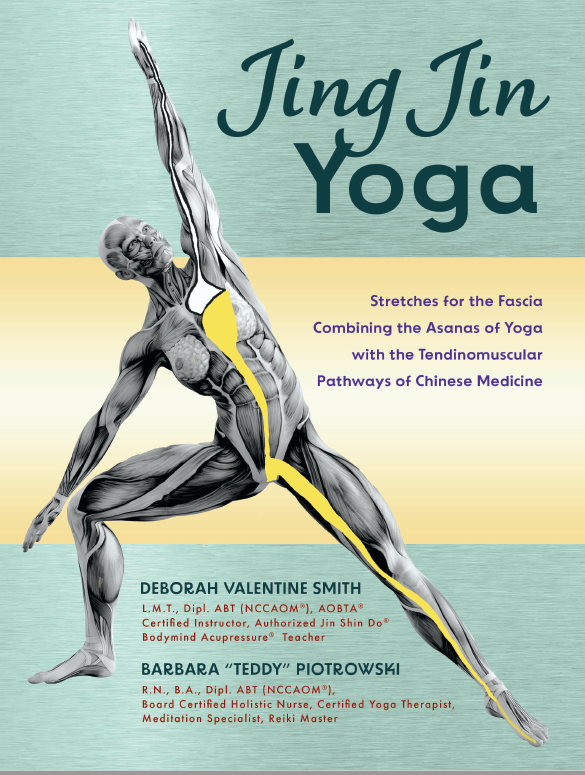
A Practical Manual
JingJin Yoga Fascial Stretches Combining Asanas & Meridians by
Deborah Valentine Smith, B.A., L.M.T., Dipl. ABT (NCCAOM®), AOBTA® Certified Instructor, Authorized Jin Shin Do® Bodymind Acupressure® Teacher
Barbara “Teddy” Piotrowski R.N., B.A., Dipl. ABT (NCCAOM®), Board Certified Holistic Nurse, Shiatsu Practitioner, Certified Yoga Therapist, Meditation Specialist
.
 Bodymind Treasures
Comments