with Debby Valentine Smith & Teddy Piotrowski Thursday January 23, 2024 6:30-8PM $25/student
In this online class we will learn about the (JingJin) Fascial Tendinomuscular Meridians and an approach to basic yoga stretches that stimulates and opens these pathways of Qi – known as “prana” in yoga.
Discover awareness with the use of breath and movement along these channels to unravel the tension and fascial restrictions associated with physical, mental and emotional stress and deepen your attunement to the subtle body.
We will explore how yoga students can incorporate the releasing power of these meridians into their daily practice for self-care.
Included in this class is a 26 minute full-body JingJin Yoga practice.
You can practice using 1)a yoga mat on the floor, 2) an elevated surface like a bed, sofa or massage table, 3) an armless chair. Bring two small blankets, two bed or sofa pillows and an open mind. ———————————————————————————————— Space is limited.
Payment options to reserve a seat for the January 23rd class Greater Harmony accepts personal checks or Venmo (online payment). Please send checks to: Barbara “Teddy” Piotrowski PO Box 222 25 S. Haddon Ave. Haddonfield, NJ 08033 or VENMO: @Barbara-Teddy-Piotrowski
and include your contact information: Name__________________________________________________________ Address________________________________City/State/Zip_____________ Email__________________________________Phone__________________
Watch a 10 minute video on the wisdom of using JingJin Yoga to address injuries and trauma both as self-care and in treating others. Gentle and powerful, it enlists the body’s healing power without re-triggering pain responses.
Looking for thoughtful gifts for the holidays? Give the gift of well-being and self-knowledge through JJY. Watch the video for the code for a $5 discount for paperback copies of the book JingJin Yoga by Deborah Valentine Smith and Barbara “Teddy” Piotrowski.
I’ve been thinking about Doing and Non-Doing (Wu Wei) a lot recently. My first formal training in bodywork was in shiatsu. I remember learning the meridian stretches and putting the body through them with the intention of arriving at the full stretch. When I was working that way, my mind was asking questions like “Am I doing the right stretch?” “Do I have the correct angle, speed, pressure?” “Am I using the correct body mechanics?” It was only after I’d had some experience that I began to realize that getting these things “right” is not the goal. When I asked those questions, through my hands, of the bodymind I was touching, the questions became not, “Is this right?” but “What is your response to this?” and “What do you want/need right now?”
The goal is to let the body tell you about its connections and restrictions as you move toward the stretch. The stretch is the Doing. The listening is the Non-Doing. The same applies in acupressure. Pressing the right point isn’t the goal. The goal is to listen to what the points have to tell you about what the body needs and its strengths. In any case the goal is not the stretch or the point. They are just a way to begin a communication.
This really came home to me in the one craniosacral course I took. We were instructed to hold very lightly at the base of the skull and sense the tissue connections and restrictions through the whole body from those two points. I realized that this was one part of the technique I was using with the TendinoMuscular Meridians (TMMs). With a light touch, I was feeling the connections and restrictions in the tissue along the meridian. But more than that, by following the energy pathways that feed the muscles, my hands were reminding the body of the way back to natural, unstressed alignment. Deep releases were happening with very little effort. Non-Doing.
I think that most experienced practitioners of exercise and bodywork are using this approach in some way, whether their practice is personal or professional. They are using the physical technique to sense both the actual state of the tissues and their yearning to return to the optimum alignment of their natural state. The goal is to recognize and assist that yearning as it finds its way back. When that connection is being made it really isn’t necessary to push or pull the body into the form that is prescribed by the technique. A gentle touch or movement can be very powerful. The Qi (Yi) of intention assists the physical process.
This way of working is very important to the individual practice of JingJin Yoga, which I developed with Teddy Piotrowski, combining yoga postures and the TMMs. It does not merely prescribe positions or exercises. The practitioner is asking the same questions of their own body that they would ask working on another. “What is your response to this?” and “What do you want/need right now?” The important part of it is moving toward the position and listening to the body along the way, acknowledging the restrictions that need to be addressed rather than pushing the body past them. In this way, what needs to be released gets the attention it needs. Like untangling a knot, we start by looking for the piece that loosens when we find the right direction to pull. JingJin stretches initially use micro movements to find the tangle and then to find the alignment that begins to open it.
Practicing in this Non-Doing way, JingJin Yoga can assist in releasing muscle tension and increasing circulation without effort or pain. As my friend Teddy says of the work: “Less is more.”
Looking for ways to prepare for the cold weather blues and give a boost to the immune system?
It is a well-known fact in Western Medicine that optimal immunity can best be achieved through regular exercise, healthy sleep and a balanced diet. Another integral part to a healthy immune system is what is commonly described as the largest external organ in the body-the skin. Superficial fascia is the lowermost layer of the skin in nearly all of the regions of the body.
In Chinese Medicine, the immune system includes a protective barrier of Qi called Wei Qi, (pronounced Way Chee) that flows in the space between the skin and the muscles (aka fascia), and is one of the first lines of defense against illness. Like an energy shield, Wei Qi prevents external pathogens from making us sick.
When Wei Qi is strong, we are less likely to be affected by climate changes, viruses and bacteria. There are things we can do to strengthen our defenses. One of those is to exercise. To engage in physical activity is essential for building Qi and ensuring that it circulates well.
Improves immune function (including mucosal and cell-mediated immunity, key aspects of your body’s first-line and sustained defenses)
Reduces inflammatory markers (particularly IL-1beta, IL-6, and TNF-alpha)
Lessens inflammation by down regulating the stress response, which may reduce risk of infections
Improves sleep quality, helping you feel rested and rejuvenated
Calms the nervous system by going into the relaxation response more often, which in turn helps your organs to function optimally, giving your body greater capacity to fight invaders and heal.
JingJin Yogastretches combine the six functional hand/foot pairs of the tendinomuscular meridians with the yoga postures that open the tissue along their trajectories. Opening the fascial channels in alignment with the meridians enhances the flow of the protective Wei Qi.
In our book, JingJin Yoga, there is a page for each JingJin Stretch that provides:
A map of the trajectory of the tendinomuscular meridian pair from fingers to toes
Related muscles and tissues affected by the JingJin Stretch
Simplified stick figures of the stretch
A description of the related JingJin Stretch
Photographs of the stretch
Modifications of the stretch for restricted movement
JingJin Yoga postures align the fascial tracts along the trajectory of the energy channels described in the maps of Chinese Medicine in order to free up the movement of Qi and blood. The maps also provide information about the direction of flow along the trajectories that encourage the opening of the channels as the flow improves. The Qi of the channels provides the energy to move what is stuck. The stretches help to align the channels and re-establish optimum delivery of the Qi and blood where it is needed.
Coming soon in November 2023…
A Practical Manual
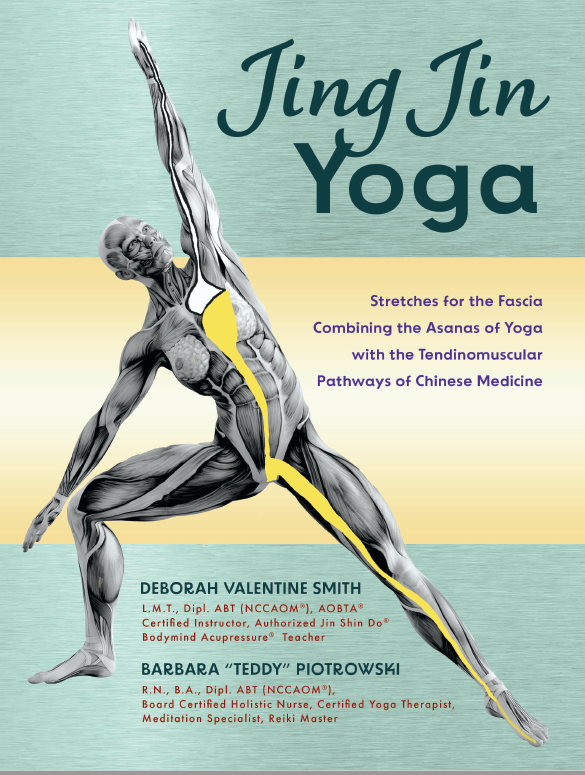
JingJin Yoga Fascial Stretches Combining Asanas & EnergyPathways by
Did you answer skin? There is an ongoing debate as to who really is #1? Although skin is touted as “the largest organ of the body, the fascia, which underlays the skin directly and also wraps around every organ of the body, is considered much larger, often ignored and largely unknown.
So fascia, or connective tissue, may be our body’s largest organ. Fascia is a very densely woven covering that adheres to every bone, muscle, nerve, artery and vein, as well as all of our internal organs: including the heart, lungs, brain and spinal cord.
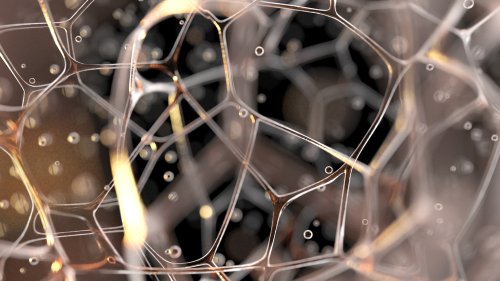
Fascia is a web-like network of connective tissue that surrounds & holds every organ, blood vessel, bone, and fiber in place!
Let’s focus on the fascia. Fascia is primarily made up of collagen and water. Its quality is therefore affected by both our age (since collagen production decreases with age) and by our levels of hydration.
When fascia is healthy and hydrated, it is supple and glides, slides, twists and bends easily with movement.
Example: Prolonged sitting can cause tension in the lower back muscles and compression of the lumbar and sacral vertebrae. By stretching the fascia, we directly influence the quality of the surrounding tissues, as they are intricately connected. Yoga trains the whole body to make it more flexible and supple. The principle is simple: Yoga movements stretch fascial strands, rendering them more moist and supple and help minimize prolonged discomfort of the lower back and hips.
” If you are unable to attain a goal, do not abandon the goal. Rather, change your strategy to reach it.” ~Chinese Proverb
As the Chinese Proverb above reminds us, the tried-and-true path is not always the best way to achieve a goal. In our practice, as in life, oftentimes we have to look at the body through “new” eyes to get to where we want to be.
So, do you think you might have a few kinks in your fascia? In a sense, if you’re already staying physically active, you’re exercising and stretching regularly, you’re ahead of the game. Muscles and fascia are so interwoven that you can’t affect one without affecting the other.If we spend months, years, even decades sitting at a desk and think that a few hours in the gym per week are going to undo all that, we’re probably kidding ourselves. Stretching a muscle with bound-up fascia is a bit like trying to stretch a knotted bungee cord: You’ll get much greater results if you get the knots out first. Some of the best methods for untying these knots is to move and stretch yourself in fascia-friendly patterns, like yoga. Presented as a practical manual, JingJin Yoga: Stretches for the Fascia Combining the Asanas of Yoga with the Tendinomuscular Pathways of Chinese Medicine introduces an innovative modality that Teddy Piotrowski and I developed (The new eyes we spoke about earlier). This is a marriage of the JingJin of Chinese Medicine (The “Tendinomuscular Meridians”) with the ancient poses of Yoga. We have refined the poses to specifically target the fascia through which theJingJinflows. The JingJin are part of the meridian system that maps channels of energy in Traditional Chinese Medicine. They are a network of superficial channels branching off the principal pathways to feed the skeletal muscles along the 12 principal meridians. “Jing” refers to channels, thus the English translation of “Tendinomuscular Meridians.” The path of these energy channels deviates from the regular meridians of Chinese Medicine, which follow a distinct path like a river. The word “Jin” is translated as “sinew” or “fascia” and includes both muscle and tendon.The JingJin are more like deltas spreading in a broad zone through the fascia to nourish muscles, tendons, and ligaments.The authors found that by putting the awareness of the trajectory of these superficial meridians together with a yoga pose, a JingJin refinement of a yoga asana produced an immediate improvement in results. The result of our combination of a JingJinmap with a yoga pose is a JingJin Stretch.
These stretches can:
Stimulate the immune system·
Improve the circulation of blood and protective Qi·
Ease stiff, strained or twisted muscles, spasms and pain along the course of the JingJin meridians
The “reset” and realignment of the fascia can include, among other effects·
Reduction of tension and discomfort·
A felt sense of well-being·
Stress reduction and increased resilience
These deceptively simple stretches profoundly benefit the whole body in many surprising ways.
Coming in November, 2023
Stay tuned to this blog for the release date.
A Practical Manual
JingJin Yoga Fascial Stretches Combining Asanas & EnergyPathways by
Sometimes “book learning” gets illustrated in the most astounding ways. When this event happened, I had been acquainted with the Penetrating Vessel (C’hang Mai) for many years already and my experience of it was pretty much what was written about it. It is one of the first energy channels to form – starting in the fertilized egg – and along with the Belt Vessel (Dai Mai), the Conception (Ren Mai) and Governing Vessel (Du Mai) gives rise to more Strange Flows (Extraordinary Vessels – Qi Jing Ba Mai), which give rise to the other energy pathways, meridians and subsidiary channels. It is also called the “sea of blood” and lies along the trajectory of the fetal notochord, which develops into the heart and blood vessels. It is also called “the sea of the twelve meridians” and “the highway conduit.” It is associated with blushing and with orgasm. Those associations should have been clues, but I didn’t really get the intensity of its action until that early spring evening in Madison Park in New York City.
I had been teaching all day in Manhattan with my teacher and mentor, Iona Marsaa Teeguarden, who was also staying with me and my children in our apartment in the Bronx. She and I had been teaching for a week already and, as was usual on the rare occasions we got to see each other, staying up late talking. Essential to this story is the fact that I had also scheduled some clients in my office in Manhattan after our teaching day was done. By 10 pm that night I was beyond tired.
My usual practice was to take an express bus home to the Bronx from the top of Madison Park in Manhattan. This is actually a thriving business area and home of several district courts during the day, but in the evening the ladies of the evening take over and the corner of 26th and Madison is usually full of people. The ladies are doing their thing on the corner, johns are cruising by in cars and taxis, negotiating and making deals; there are always several people waiting for the express buses that both begin and end their route there. There are usually two or three of them idling while the drivers take their dinner break. If you are a New Yorker, this is a pretty safe place to wait for a bus. Lots of people, limited wait.
Speaking of New York, let me say a word about Protective or Defensive Qi (Wei Qi). The Wei Qi is described as running between the skin and muscles and preventing the invasion of “aggressive qi,” which in Chinese Medicine usually means climate: cold, wind, damp, etc. But in New York “aggressive qi” can come from human beings. Your Wei Qi becomes a personal radar scope, registering anything that enters – or even sends too much energy toward – your personal space. Most New Yorkers live in the realm of Wei Qi. Oddly enough, in the aftermath of 911, the city seems less prickly to me, perhaps because there is a sense of community fostered by shared trauma, but this was before that. Especially in Manhattan, the lines between poor and wealthy neighborhoods get fuzzy and the physical distance between them is mostly in the mind. If you take public transportation you get to meet everybody except the limosine people and they’re a different kind of dangerous. Wei Qi seems pointless to the point of ludicrous when you are literally packed in, tushy to tummy with your fellow New Yorkers during subway rush hour. But if you’ve lived it, you know what I mean. My shoulder may be pressed into your chest, but I will know instantly if your intentions aren’t honorable and I’ll be ready for you. A hundred years ago ladies used hatpins to protect themselves. Today, it’s pretty much a very loud, embarrassing voice directed at the miscreant with lots of attitude. Unless, of course, you’re dealing with one of the obvious crazies and then it’s a whole other story. But I won’t go into that here. My point is, that as an ordinary New Yorker, you never know who’s in your vicinity and you must be alert. If you have a modicum of self-preservation, you quickly develop three hundred and sixty degrees of awareness around you at all times.
My point in bringing this up is that the Wei Qi “wells up” to the surface into the Sinew Channels that feed the muscles from the principal meridians. If there isn’t a lot of Qi to go around, they tend to get short-changed unless there’s a screaming threat off the starboard bow.
This particular evening, my level of Qi was pooling somewhere inside longing for the comforts of home that were still an hour away. I did not notice – at first – that the top of Madison Park was deserted. No buses, no hookers, no commuters or taxis or johns. Not good. I also did something I never did when I was more alert and survival oriented – I sat down on a park bench facing the sidewalk on 26th street to wait for the bus. The alarm system was turned off and my head was in my navel.
I only became aware of the kid with the stick when he was already standing next to me on my right side. It is telling that I was not startled or apprehensive. I was too tired. The kid was slapping his stick – a broken rung from a kitchen chair? – against his palm as he said “Do you have any change?”
Now this is a fairly common question on the streets of New York. Homeless people on the streets and hustlers on the subway are constantly asking for money. Every New Yorker develops his or her own unique response to this. A friend of mine makes sure he always has a bunch of quarters in his pocket so he doesn’t have to say no to anyone. Most people simply refuse to acknowledge the presence of the one asking. Eye contact opens you to that person and you don’t really know what you’ll find there or in yourself in response. Compassion? Sympathy? Delusion? Despair? Danger? Too risky. My usual response is to mutter, “No, sorry,” with just a quick glance of acknowledgment in the other’s direction. Frankly, I wish I could hand out $10 bills. I know how delightful it is to get unexpected money. And, yes, I know what most of those bills would go for, but that’s the deal when you really give away money. Give away. No strings trailing back to your own life lessons.
However, I was pretty much trapped here. In my surprise at the kid’s presence I had turned my head to look at his face full on for several seconds. So I said, “No, I just have enough for the bus.”
“Well, then,” he said, still slapping his stick against his palm, “Do you have a dollar?”.
At this point in time, some of that deep pool of Qi started to climb towards the outside. I had the feeling that there was some kind of coercion going on here. Not much, admittedly. The kid was about twelve and skinny and not as confident as the stick would like me to believe, but something had to be done.
I had worked for awhile with Bronx teenagers who were survivors of sexual assault and abuse and I took the “street fighting” classes in the program right along with them. I didn’t do much street fighting on the desert in California where I grew up and figured it might come in handy sometime. This was the time.
The first thing we learned in our class was to use the voice. Put power into it and yell. Sometimes that’s all it takes to put off a predator who’s looking for weak prey. So, almost without thinking, I put all the qi I had at the moment into my voice and said, very loudly, “NO!”
The kid was obviously startled and he looked off to his right at something across the empty street. How had I missed them? Coming toward us was a group – I won’t say gang – of maybe six or seven kids. They seemed to be led by an older kid of about fifteen who was carrying a baseball bat. And no, they didn’t have Little League uniforms on.
The kid next to me said to the leader, “She yelled at me!” This was clearly not playing fair and he was outraged.
The leader beckoned him over and the group of them proceeded to have a conference there on the sidewalk about 10 feet away from me.
I was still sitting on the park bench, in pretty much the same relaxed (exhausted) posture I had been in since sitting down, but my brain was starting to wake up. I’m saying to myself, “They are deciding whether to leave the crazy lady alone or to beat the crap out of her.”
At that moment I felt every ounce of energy in my body drain down into my legs. It was the most remarkable sensation. The image in my head was like a cartoon thermometer dropping down to the bottom. And as I observed the physical phenomenon, my head said, “The Classics say that in anger the energy rises to the head and shoulders. In fear it drains into the legs. I must be afraid.”
At that moment, a yellow cab with its blessed halo, the “vacant” light on top, turned the corner onto 26th street and headed down the block toward me. I do not think I walked to the street. It would have given the kids too much time to notice. I think I levitated like I was on a pogo stick to the street, just as the cab was passing, waved it down and jumped in.
And that, my friends, is the meaning of the term “highway conduit.” You want to get somewhere fast, you take the quick road. And in a pinch, “the sea of the twelve meridians” can draw all the energy from all the regular channels and commit it to survival, whether that means sending it to the head and shoulders to fight with teeth and claws or sending it to the legs so you can run the hell away.
Iona still laughs at me because I didn’t just take the cab home. Nope. I was a New Yorker. I got out at the next stop on the express bus line to catch the bus home, my legs shaking so badly from the aftermath of the adrenalin rush that I could hardly stand.
For more on the Penetrating Channel and Fright, see “9/11 and Running Piglet Qi”
These are not the only stories about the Penetrating Vessel. There are many other functions; including the very important male and female developmental cycles: “The Cycles of Seven and Eight,” that will have to wait for another time.
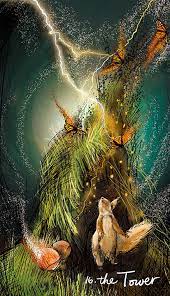
My towers are constructed from choices of viewpoint and belief.
Where you build your tower determines what you see.
When the towers fall, I am aware that I have been trapped in caskets of my own making.
An Egyptian sarcophagus, elaborately painted with superficial details while hiding flesh and bones.
Breaking out is both liberating and terrifyingly vulnerable.
In one of those processes, I dreamed of a poplar tree in the front yard of my childhood home that cracked open and released a beautiful butterfly.
A reminder that the structures we build so seriously can come between us and the beautiful, scary, ephemeral nature of life.
The Star (Rider/Waite)
The Star is light in the vast darkness of the universe.
Wishing on a star, we ask for access to the possibilities in that vastness.
The pouring of water to the land and river is an offering,
An indication of the humility required to be open to the guidance of spirit.
Our own view from the tower is limited to what we can see,
So how can our wishes transcend what we already have?
When the tower comes down,
There’s an opening for a vaster wisdom to make itself known.
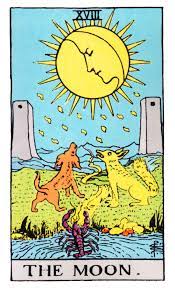
The Moon (Rider/Waite)
Let what is hidden remain indistinct, to be revealed in its own time.
Trying to prematurely sharpen the outline eliminates crucial aspects that are part of a still murky truth.
In this process, age has advantages.
Looking at events of 40 years ago, I see that they are still taking shape.
Like things in the moon’s shadow, the outlines are forever changing.
There is some relaxation to accepting the ambiguity as a function of time.
In the mystery, we expand.
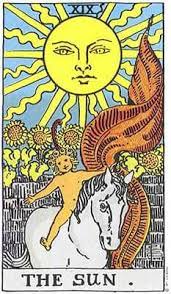
The Sun (Rider/Waite)
In every version of the Sun card, the rays are prominent.
In Egyptian carvings they have little hands to touch and caress.
Bright, warm, and expansive,
Basking in the sun is what Joy feels like.
Joy is playful, like the child in the card, riding the horse without saddle or reins,
Confident in the moment, moving freely with change.
The Sun reminds me to look for the sources of light and warmth in my life.
Just a spark of interest, curiosity or delight can be coaxed into flame when I give it space in my heart.
Why do we hold back?
Our nature is to shine and to encourage the spark in each others’ hearts.
The sun rises each day for everybody, no matter what.
Every dawn I have something to be thankful for.
A daily gift of joy.
Tower/Star/Moon/Sun
The blinding destruction that brings down our carefully constructed towers leaves little to be sure about, lots of questions and some fear of the dark.
In that chaos a star appears in the darkness to guide us.
The light grows with the rising of the moon, but the way is still in shadow.
It is a time to tolerate ambiguity and watch what arises from intuition.
A time to explore rather than choose.
A time to be curious about what is only partially revealed; letting commitment wait until things are fully revealed by the Sun. The Star and Moon lead us in the direction of the light. They give us hope for possibilities that can become fulfilled as we allow the Sun to fully reveal the path of joy.
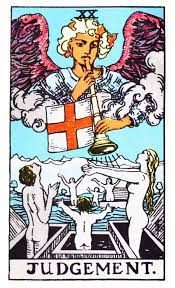
Judgement (Rider/Wait)
I think of Judgement Day, when souls will be sent to heaven or hell.
But in this Tarot journey, it is almost the end.
In the light from the Sun we have examined what is arising within us.
We can distinguish between illusion and joy, and choose what to keep.
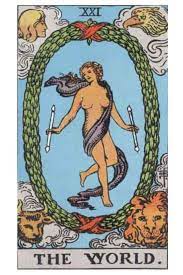
The World (Rider/Waite)
Symbols of the directions, the elements, the sources of life, all together, turning.
Like the yin/yang symbol, everything makes up the oneness that is the Tao.
What has been, what is, what will be.
All are coming and going seamlessly within the totality.
“The universe” is that wholeness,
Creation arising from the elements as they are dispersing.
Ouroboros. The circle of living and dying.
On “Arriving.”
My accumulated knowledge and experience is a bundle I carry with me.
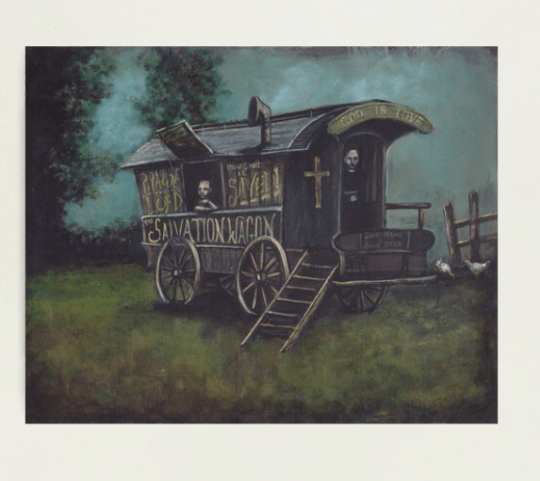
Like the old time traveling salesman with his wagon and horses,
I travel from person to person, telling my stories;
Sometimes exchanging something in my bundle for a place around the fire.










 Bodymind Treasures
Comments